
QR Menu vs Printed Menu: Which Is Better for Restaurants?
Compare a QR menu vs printed menu across guest experience, updates, ordering, accessibility and restaurant operations to decide where each format fits.
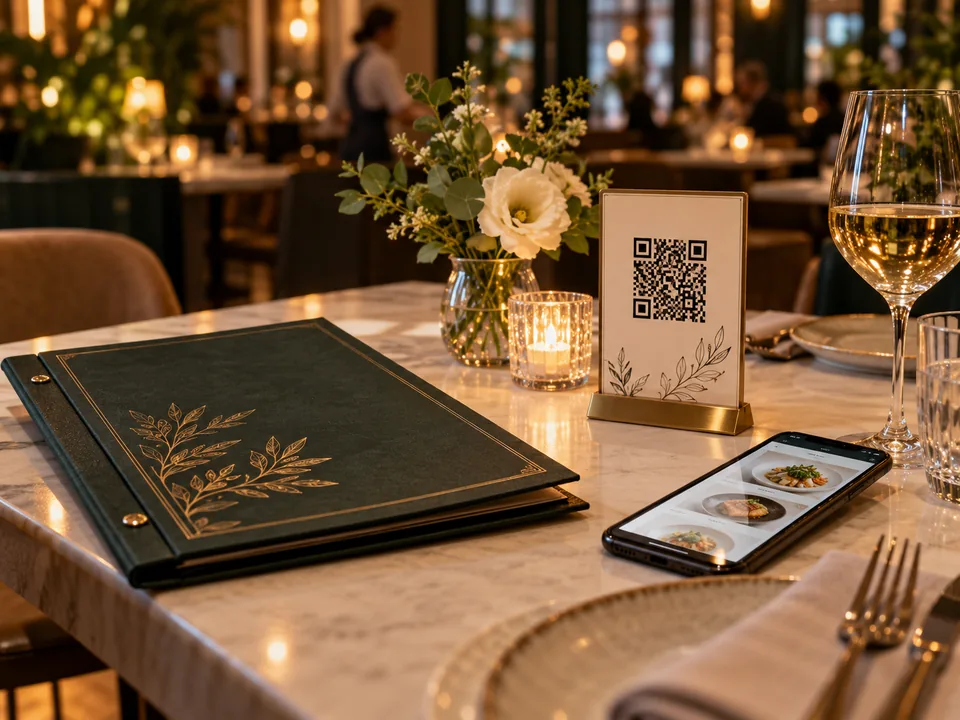
The QR menu vs printed menu decision is not simply a choice between digital and paper. Each format changes how guests discover food, how quickly a restaurant can update information and whether the menu can connect to ordering and service actions. For many restaurants, the best answer is not to eliminate one format completely, but to understand what each does well and build the guest journey around real service needs.
A printed menu is familiar and immediate. A QR menu is flexible, interactive and easier to connect with a restaurant QR ordering system. The right balance depends on the restaurant concept, guest expectations and the type of experience the team wants to provide.
QR menu vs printed menu at a glance
A printed menu is a physical object with fixed content until it is reprinted. A QR menu opens a mobile digital experience whose content can be changed without replacing the QR code. That difference affects everything from price updates to multilingual service.
If the QR code opens only a PDF, the experience remains close to a paper menu delivered on a screen. If it opens a structured restaurant digital menu, the restaurant can add categories, item details, dietary information, options and ordering actions that are not practical on paper.
Where printed menus remain strong
Printed menus require no phone, battery, camera or connectivity from the guest. They can also contribute to the physical character of a restaurant when typography, paper and presentation are part of the brand experience. Some guests simply prefer holding a menu, especially in restaurants where browsing is part of the occasion.
For that reason, adopting QR does not automatically mean removing printed menus. Restaurants can keep printed copies available while using QR as the faster, more interactive path for guests who want it.
Benefits of a QR menu for changing content
One of the clearest benefits of QR menu technology is that the destination can change while the physical code stays in place. A restaurant can update item descriptions, prices, availability or categories without printing a new menu for every table.
Structured content also makes it easier to control when products are available. Breakfast items can be shown during breakfast hours, for example, while unavailable dishes can be hidden or marked according to the restaurant's workflow.
Digital menu vs paper menu on a phone-first guest journey
In a digital menu vs paper menu comparison, the digital version becomes more valuable when the restaurant wants the guest to do something after browsing. A structured QR menu can connect directly to item customization, a basket and table ordering. It can also provide buttons to call a waiter or request the bill.
Paper remains excellent at passive browsing. Digital becomes stronger when browsing is only the first step in a connected service experience.
Multilingual menus
Printed multilingual menus often become crowded because the same dish needs several descriptions on the same page, or the restaurant must maintain separate printed versions. A QR menu for restaurants can present only the language selected by the guest, keeping the interface cleaner.
This can be particularly useful in tourist destinations, hotels, airports and city-center restaurants serving international guests. The restaurant still needs to review translations and food terminology carefully, but the digital format makes language switching easier to deliver.
Allergens, dietary information and item detail
Space is limited on paper. Restaurants often shorten descriptions or move allergen notes to separate symbols and legends. A digital menu can give each item its own detail view, making room for ingredients, allergens, dietary attributes and preparation information without making the main menu visually dense.
That does not remove the restaurant's responsibility to manage food information accurately, but it can make that information easier for a guest to find.
Can a printed menu take orders?
Not by itself. A printed menu depends on a staff interaction for ordering. That may be exactly what a restaurant wants. But when queues, busy terraces or repeated order additions create delays, digital ordering can offer another path.
A connected QR experience can identify the table, let guests choose modifiers and send orders with the correct context. To understand that workflow in detail, read what a QR menu and table ordering system is and how it works.
Guest choice is often better than forcing one format
Restaurants should be careful about making technology feel like a barrier. If a guest cannot or does not want to scan a QR code, staff should still be able to help. A QR menu works best when it creates convenience rather than making the guest solve a technical problem before ordering.
A practical approach is to make QR the fast self-service option while keeping a small number of printed menus available. This lets the restaurant benefit from digital updates and ordering without excluding guests who prefer paper.
Operational considerations for restaurants
Before switching menu formats, restaurants should look at the staff side as well as the guest side. A digital menu needs clear administration for categories, items, prices, images, modifiers, availability and translations. If table ordering is enabled, incoming orders and service requests also need a workflow that staff can manage reliably.
The technology should reduce friction, not move it from the dining room to the back office.
Which is better?
For static browsing and a tactile brand experience, printed menus still work very well. For frequent updates, multiple languages, richer item information and direct ordering, a structured digital menu has a clear advantage.
So the most useful conclusion to the QR menu vs printed menu comparison is not that one must replace the other. Restaurants should choose the format that fits each interaction. QRNeto Restaurants is designed for businesses that want the QR option to go beyond viewing a menu and become part of a connected table-service workflow.